Feng Shui: Crimea, Ukraine – Mastery Program
Leave a reply


The last two months, I have had the rare luxury of not adding more frequent flyer miles to my account by staying in Seattle to diligently work on two books; Feng Shui: Truths, Myths and Misconceptions and The Essence of Chinese Tea.
To give you a little taste of what’s to come, the story below is taken from my book The Essence of Chinese Tea. Hope you enjoy it!
Photo: Wikipedia
I have been fascinated by crop circles for some years. However, once in a while, I believe there might be some created as a hoax. But because of the consistent neat and intricate patterns, created by UFOs or other mysterious forces or not, I find it is impossible to be the work of man. In the world of art design, how often does one encounter such unique and beautiful designs by humans? The crop patterns not only have been changing in size, from small to large, but the designs have developed from very simple, to extremely complicated in its detail. The recently appeared 250 meter by 60 meter jelly fish crop circle is most amazing! Form Defines Energy! I do believe the design represents some sacred meaning or message.
All things in the universe are always changing, and nothing stays the same. The Wu-Xing theory describes this process as the way and the mechanism of change. It is mostly applied in interpreting the dynamic processes and interactions caused by change. In Chinese medicine, we are able to see how the sophisticated use of the Wu-Xing theory helps in diagnosing and treating disease. Unfortunately, today most usage of the theory’s applications is limited to Chinese medicine. This is most unfortunate, as it could be a very powerful tool to help us understand and also provide guidance to all aspects of human endeavors and not just Chinese medicine. If more can understand how to apply the theory, the more we will all benefit.
Take for example, the 2001 tragic incident of 9-11 in the USA. Why did it happen? What was the best way to respond? At the time, there was no shortage of opinions, analysis or suggestions on the reasons for the incident to take place on how the U.S. should respond to the attack. But there was never a clear and wholesome picture of the devastation. Had our leaders in government been able to take a step back and see it from the laws of natural principles, from the Yin-Yang and Wu-Xing theory point of view, they could have better understood the cause of the incident, enabling them to come up with a more wholesome way to respond. This would have helped to obtain a good result. Unfortunately, they were unable to see it from that perspective. Therefore, today, eight years later, President Obama is still sending more troops to Afghanistan to deal with the Taliban.
When the ‘Mission-accomplished’ George Bush had issues with Saddam Hussein of Iraq, he ordered to attack and invade Iraq. Was that the best way to handle this issue? Through analysis based on the Wu-Xing theory, it was so clear that his decision was not the right approach to the situation and would thus lead to very negative consequences. In Blue Mountain Feng Shui classes, we had discussed this subject way before the invasion. We predicted the outcome and sure enough, it turned out to be exactly what we had expected. In today’s current events, how should the United States deal with Iran or North Korea? Could the Wu-Xing theory provide guidance? Yes. May be it’s time for President Obama to a take these classes!
Nowadays in China, except for those in the field of Chinese medicine, most people regard the Wu-Xing theory as a useless remnant of an ancient dinosaur. It’s unfortunate that modern Chinese society is unaware of the benefits it has to offer. In fact, the Wu-Xing is a very powerful tool for understanding the course of changing and transformation for all worldly events. On a large scale, this knowledge should be the required study for all world leaders, military commanders, the CEO of corporations, all people setting economic policies, education systems, etc. Oh, how it could benefit us all!
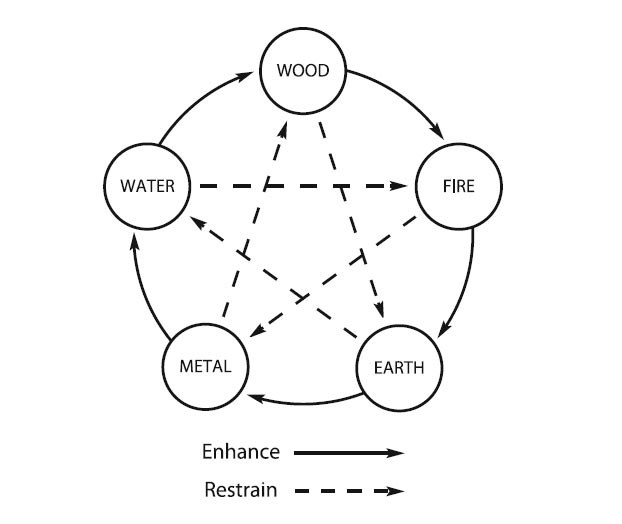
Recently, a Ukraine student asked me the following question. “Since tea is a Wood element and there are many different kinds of tea such as, green tea, black tea, Oolong tea, Pu-er tea, etc., can each tea be classified into different elements in the Five-Element theory?” It took a moment for me to absorb the question and then I did not know where to begin to address his question.
For years I have encountered many questions regarding the application of the Five-Element theory. Most people, who have asked questions regarding this theory, do not have a clear grasp of its principles. This is truly understandable, as many feng shui books that mention the Five-Element theory do so only as a window dressing for the book. It seems to be standard practice to mention some form of both the Yin-Yang and Five-Element theories; however, it is rare to find a book that discusses the relevance and application of these theories in real terms. No wonder there are many who are confused!
So what is the Wu-Xing theory? Let’s try to break it down so we can have a better understanding of the principles behind the theory. In an earlier blog we talked about the Yin-Yang theory. The ancient Chinese used the Yin-Yang theory to describe the existence of all things and phenomena in the universe. From this we understand that there are four aspects of the Yin-Yang theory.
1. Yin and Yang unify and oppose
2. Yin and Yang entail each other
3. Yin and Yang increase and decrease
4. Yin and Yang transform into each other
Through these principles, we try to achieve balance and harmony.
So how does this relate to the Wu-Xing theory? To compliment this, they used the Wu-Xing theory to describe the dynamic transformation in the universe. Wu means five, Xing means passages. So, the Wu-Xing, or five-passages, represents a type of function that represents a form of change, a transformation of the characteristics that connect and interact with all thing in the world of time and space.
So, the key word here is interaction. This is a very important point to remembered. These interactions are transformed through three fundamental processes which affect their relationships and energy.
They are
1. enhancement
2. restriction
3. resonance

This differs from the Greek and Indian system as it relates more to the interactions between the elements as opposed to their individual characteristics.
In the Western world, Jesuits first rendered ‘Wu-Xing’ as ‘Five-Elements’, obviously having in mind the Four Elements of ancient Greek philosophers. This translation became very popular and is adopted by Needham in his renowned book ‘Science and Civilization in China’.
Unfortunately, that planted the seed of confusion and misunderstanding, causing people to associate the Five-Elements as just material elements. It left out the main point! As we discussed earlier, it is the interaction or relationship of the elements that should have been emphasized, not the motionless ‘fundamental’ substances. So, this belief has created many to stretch this misunderstanding in its application.
Nowadays we often come across a feng shui analysis of a table using the Five- Element theory. The following is an example of such a scenario. “This is a good table since it has all five elements; the form is square (Earth element), it is made of wood (Wood element), the color is red (Fire element) has metal legs (Metal element), and there is a wave-like (Water element) motif on the table…”
Not only is this kind of stretch rather comical, but there is no relevance with the quality of design either. However, today it is common to find many books using this type of stretch claiming they are following Wu-Xing principles. And they truly believe this is correct, because this is what they have been taught. So really it is no fault of theirs.
However, it is a shame that the true theories are not fully understood. The Wu-Xing theory is not easy to grasp at one session. It takes time to absorb, digest and comprehend all the aspects of its principles. For those that have taken the Wu-Xing class at Blue Mountain institute and are not yet confident in its understanding, it is always good to go back over your notes and to once again come to class to build on your ever expanding knowledge.
In this tough economic climate, it is a good opportunity to step back and re-evaluate our living situation and our lives in general. To help guide us, it makes good sense to start with the feng shui principles. But where do we start? Trying to implement the information taught by Master Hsu is not as easy as imagined. In a sense it’s like reading a self-help book. You read it and think you comprehend it, but changing your habits is never simple.
However, there are simple things we can start with in feng shui. I am working on my front yard. Is the path to my entrance clear without obstruction? Are we protected from the energy of the road? Does it look presentable? Do I need to prune a few trees, pull some weeds or trim the hedge? Stepping back and taking a fresh look at something you observe everyday may spark some new vision. Spring is here. Planting some cheerful flowers to greet everyone in the neighborhood is only a small step, but one that will bring a smile everyday.
