Category Archives: Feng Shui

Is The Office Cubicle Driving You Mad?

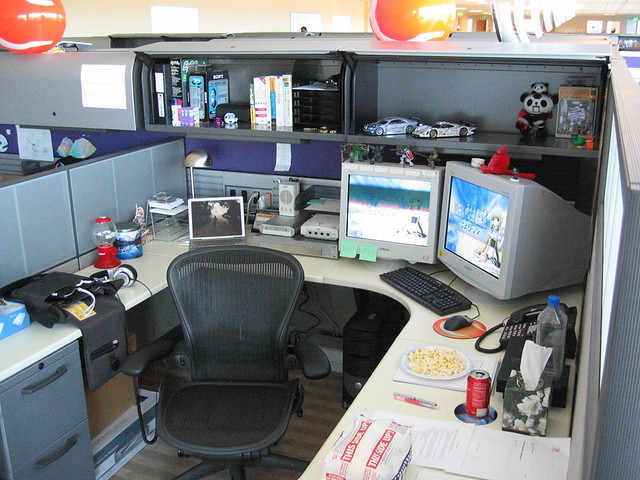
Herman Miller invented the cubicle in 1956, with the idea of creating more privacy and helping to reduce distraction and increase concentration.  Since then, the  cubicle has become a standard feature of modern office design in the American workplace.  Offices designed using this modular unit, often called mouse mazes or cube farms, have become the symbol of human conditioning, and of the reduction of  individuality to uniformity and blandness.

One thing we know is that most people do not want to work in a “cube world”.  A common report from those working in cubicles is that they find themselves frequently checking the time, anxious for their workday to end so they can get out of the space.  After all, a cubicle design is similar to a prison cell.  Staring at a partition wall in such close proximity to one’s field of vision, throughout the long work day, replaces feelings of openness and comfort with a sense of being trapped.  This feeling, and the resulting impact on creativity, can lead to anxiety and agitation, and even make you feel that you might be going mad. How much of the work-related stress and low productivity of corporate America is due to this working environment?  Is this one of the reasons Americans seem to need to work longer hours in the office to finish their work?

Corporations at times try to save money by resisting change that benefit employees. The irony is, such changes in the long term actually benefit the corporation, as they can increase employee productivity, reduce stress levels, and increase overall morale.  But often enough, even if a company wants to move away from the cubicle work space; it is hard for most designers to know what to change to.

There have been few attempts to liberate workers from these constricting cell since the cubicle was invented.  Most changes have been superficial updates that meet technological and aesthetic advances. Over a decade ago, Knoll took on the challenge of reinventing this modular office unit, and hired a well-known architectural firm to take on the task.  However, after two years and millions of dollars spent on research, development, and engineering, they only managed to create a more expensive design that did little to resolve the core issue.

The fundamental reason for this impasse is that industrial designers have not been able to identify the real issue behind the cubicle problem. When you do not feel good in the box, you cannot argue with the feeling.  Although the cause may not be clear, the feeling itself is real and valid.

Naturally, when architects, interior designers, and furniture designers make any attempt to “improve” the design, they tend to understand and approach it from a purely physical point of view.  As I have often commented, the blind spot for designers throughout history has been that they only see a building or object as a physical body, but not as an energy body –  nor as an information carrier. There is much to learn from the wisdom of the traditional Form School feng shui in which all objects and manifestations are seen on all three levels:  as a physical body, an energy body, and as an information carrier. Designing with this in mind will naturally create functional, economical and beautiful designs.

God created the human body with a strong spine at the back to hold up the entire body, and  with openings in front, such as our eyes, nose, mouth, and ears.  Therefore, to live in resonance with our physical body, our living environment should follow this same pattern. In our daily lives, we always feel better when we position ourselves with some protection behind our back with a nice open space in front of us.

Throughout the history of world, people have followed their instincts and built their houses with the backs against a mountain, hill or more protective objects and the front doors facing bodies of water such as rivers, lakes, oceans or facing a nice field or other open space.  This is also how we should build our work spaces.  The innate flaw of the cubicle office is that it violates this feng shui design principle  which is based on natural laws.

In the terminology of Form School feng shui, we need to have Water (for expansion) in front andMountain (for support) at back. Why is this more ideal? In simple language, when we are protected from behind, (for example with a wall closely behind us), we feel more secure, and when we feel more secure, we are more relaxed.  When our bodies and minds are more relaxed, the energy in our body flows better, and contributes to a higher spirit, happier feeling and more productivity in our work. Furthermore, having a nice open space in front of us allows an extension of view and vision.  This not only helps release our stress, it also frees and expands our thoughts, enhancing creativity.  (This is why people nowadays need to have more windows as life becomes more stressful.)

The cubicle design turns this whole principle upside-down.  The computer is placed on the working counter against the partition wall (facing a mountain); co-workers pass or approach from behind, causing one to feel vulnerable.
Regardless whether one is aware this impact or not, it builds internal invisible stress. To help mitigate the problem, and in an attempt to bring life to an unexciting space, people who work in cubicles put photos, plants and even mini-fountains in their work spaces.  Some workers place small mirrors in front so that they can see reflections from behind without turning.  All these design maneuvers may help to some extent, but they do not fundamentally fix the problem.  As long as there is no Mountain behind the chair, the insecure feeling remains.

Most bosses would not feel comfortable working in cubicles; in fact, they have the luxury of well-protected private offices. It’s hard not to wonder why bosses would put their employees into spaces that they themselves would not feel comfortable in.  Without increasing the space, it is still possible to create a working environment making people feel much more comfortable.

Some office designs do have cubicle partitions that fully protect the worker, with the opening to the side, so that people pass or approach that side.  Many people who work in cubicles do this intuitively, when they have the space to do so, by orienting their computer or other work activities toward a side wall rather than toward the back wall.  Physically, this is not as comfortable, but emotionally it will be less stressful. This is a definite improvement. If this cannot be done, it may possible to put some large plant at one’s back, as a buffer between one’s back and the world outside the cubicle.

Imaging how much better it will be, when architects, interior designers, furniture designers — and all designers! — understand the traditional Form School feng shui.

Birthday Celebration

Birthday celebration has been an important and joyful event in modern human living.  For parents, the birthday of a child brings much happiness to know their child has experienced another year of emotional, mental and physical growth. However, in holding parties and giving presents to the birthday person, many usually don’t give much serious thought on “What are we celebrating?”, nor for the birthday person to think “What entitles me to expect and receive presents in simply getting one year older?”

In old time China, children celebrate birthdays for their parents and elders to express their gratitude for the love and support they have received from them.  Rarely did parents celebrate birthdays for their babies and children as in the West.   However, nowadays, all are westernized.

There is nothing wrong to find opportunity or an excuse to have a joyful gathering, to enjoy a good time together.  On the other hand, the deeper meaning of birthday celebration may have been lost.  In China, it used to be thought that ideally birthdays should be a day for reflection.  This is a day for people to reflect and appreciate the love and support they have received in the past year from family, friends, society, Heaven and Earth.  This is a day for people to reflect on their inner growth and outer progress in the year just past and to see if it matched or exceeded what they have received from outside in return. This is a day to meditate on making adjustment and setting a new goal for the coming year.

For the birthday person to show their appreciation for the love and support they have received, this is an occasion to give instead of to receive.  In many cultures, such as the traditional American Indian culture, instead of the birthday person receiving gifts, they would give gifts to those who come for the celebration.

I always tend to shy away from celebrating birthdays in the “normal” way.  This year,  in taking advantage of the rare occasion that I  am able to stay home for more than a month without  traveling abroad,  I decided to  celebrate my birthday with  a “21-day Lemon Juice Fast” to cleanse  my body.  Feng Shui is about designing a good living environment. Our Body is the living environment for our spirit and soul. Regular detoxification practice is a good way to ensure good feng shui for our spirit and soul.

I have now entered the 6th day of fasting and feel much better already. I will give a final report at the end of this fast.

Feng Shui and Religion

Does religion have a role in Feng Shui?

This is a frequently asked question.
The answer is: No.  Feng shui is not a religion nor has it ever followed any religious tradition or practice.

However, most religious groups do apply feng shui principles in building their temples and monasteries. Most Taoist and Buddhist temples in China are built on a site that nourishes spiritual energy.

Last November, I was invited by the headmaster of Yunjui Shan (雲居山Cloud Residing Mountain) ,in Jinagxi, China,  to locate a proper site to build a new meditation and training center for the monastery. This Ch’an (zen) monastery, was established during the Tang dynasty and has over 1200 years of history.  The headmaster was very much into feng shui and I found him also sensitive to the energy of the land.  Since my suggestion was very much in accord with what he had in mind, he was very happy with my visit.

This past March, he once again asked me to help with the proper positioning of the gate for a new temple. High up in the mountain, in the rain and cold, the master walked so briskly through the woods and muddy ground, that I had to pay attention to keep up.   Overall, it was a most interesting and rewarding experience.

From all the Buddhist and Taoist temples I have visited, I hardly find a temple without good feng shui.  Although in general, the energy at such sites is more supportive of spiritual cultivation and may not necessarily support business or commerce.

Good feng shui for business requires a more mundane energy, which in general means sites are on low ground, such as cities close to bodies of water.  Temples, on the other hand, are for spiritual cultivation, thus are mostly located on mountains or higher ground in a city.

Balance with the intended purpose is one of the key considerations of feng shui design.

On “Living Environment”

body & mindThe purpose of Feng Shui is to create a good living environment for all living beings. The “environment” in Feng Shui concepts exists in all scales; the planet, continent, region, city, neighborhood, house, room, and down to a favorite chair.

It is important to realize that our body and mind co-exist.On a more fundamental scale, our body is the “living environment” of our mind, and our mind is the “living environment” of our body. By taking care of our physical health, we provide a good living environment for our mind.  Therefore, a sound and tranquil mind, provides a good environment for our body.  This is the very first Feng Shui concept we need to concentrate on. Good Feng Shui design for harmonious living begins with our bodies and minds.

Ask Mother Earth for Answers

Photoxpress_4780633

Human beings live between Heaven and Earth, nourished by Yang and Yin energy.  The energy of Heaven comes downward from above, manifesting as sunshine, rain and so on.  The energy of Earth rises upward from below, manifesting as food, water and other nourishing products.  Heaven (yang) energy implies dynamic expansion while Earth (yin) energy implies collection, connection, cooperation and nourishment.  Without the effects of Earth’s energy that emerges to balance the outward expansion of Heaven’s force, there will be conflict and strife.  What are the most powerful factors in manifesting Earth energy, the energy of connection and cooperation?  The answer is trees, forests and all vegetation.  The places that tend to have more conflict in the world are just those

places that lack forests, or that have undergone recent, sudden deforestation. In modern history, there are positive correlations between the depletion of natural forests and the general level of strife and chaos in the world.  This is the source of the problem.
In the arenas of politics, economics or other specialized spheres, there is constant effort to control chaos and conflict.  The emphasis is not on how to solve the issues but on how to not create further problems.  Due to this, there will always be an uphill battle to find a fundamental solution to today’s issues.  From a feng shui perspective, the best solution is found in Mother Nature.  We must look at it from an energy (chi) level.   Chaos and conflict means there is too much Yang energy so it is necessary to increase the nourishing Earth or Yin energy or increasing energy for cooperation and support.  How do we go about this? We must begin by planting trees and establishing greenery all over the world.  In the meantime, where forests are abundant, water will be abundant. And water, to the planet, is like blood in the human body.
The global warming and the increase of CO2 is the modern urgent concern.  While people search for different ways to find solutions, which are often complicated, we should just ask our Mother Earth for a solution.   According to a scientific study, 20% of CO2 is attributable to deforestation, which is more than all of the world’s cars and trucks combined.  Let us stop and take the time to think.   How much of a positive impact will there be in solving the CO2 issue if instead of deforestation, we increased forestation?

Divine Acceptance: Thoughts on the Afghanistan War

In feng shui classes, students often ask: “What happens if I know my place has a feng shui problem, but I cannot change anything structurally (as often it is a rental), nor can I move out any time soon?” My answer often is: “When you cannot do “anything”, there is always “one thing” you still can do: that is acceptance.”

This answer sounds as if we are avoiding the question.  Yet it does have significant meaning to our life.  We find it hard to accept things that are negative, imperfect, defeats us and so on. Life is full of imperfections and the inevitability of those imperfections is hard to accept.  Accepting the reality of the moment does not mean sticking to that moment.  To accept the reality of the present situation does not mean being limited by it; it means knowing the place from where one must start, and once that is known, the next thing to do is to begin the new journey.  And then you know, in due time, things will change.

The United States has been fighting the war in Afghanistan for 8 years and although with 68,000 troops stationed there, we are slowing losing control.  Gen Stanley McChrystal requested a troop surge of a minimum of 40,000; stating, otherwise, the U.S. will be defeated.  Even with that surge, he also knows the U.S. will not win the war in years to come.  As President Obama continues to ponder the strategy, he is clearly aware of what is at stake.  Regardless of hunting Al-Qaida, protecting Afghans are the reason we cannot withdraw.  The fundamental reason to stop us to consider a withdrawal is: we cannot accept defeat, yet we could admit we made a mistake even as early as 2001 when the US invaded Afghanistan.

The rampant Hamid Karzai government’s corruption, the wide spread fraud in the August 20th president election, should be seen as the kindness of   “Heaven” to inform the U.S. to learn the lesson of acceptance.  Afghan has a long history, much longer than the United States.  Beneath the poverty and misery, its people are imbedded with wisdom, pride, strength and tenacity from their deep culture.  They do not need our protection.  It takes wisdom and courage of our new and young president to learn the lesson of the Divine Acceptance; the teaching from the ancient Chinese saint Lao-Tzu, and the lesson from our all accepting Mother Earth.

Accept the train to enter the station, otherwise it cannot move on to the next station.

60-year Celebration

CB013129On October 1st, China held an elaborate ceremony to mark the 60th anniversary of the People’s Republic of China. The impressive parade was followed by a jubilating evening party with an attendance of sixty thousand people.  Indeed, it was a big national party.   In the West, a centennial is a significant bench mark of any celebration, whilst in China, 60 years has significant meaning.

The ancient Chinese use Ten Heavenly Stems (Jia, Yi, Bing, Ding, Wu, Ji, Geng, Xin,Ren, Gui) and twelve Earthly Branches (Zi, Chou, Yin, Mao, Chen, Si, Wu, Wei, Shen, You, Xu, Hai) combining  the two together to form a cycle of sixty.  Heavenly Stems and Earthly Branches were used as the x and y axial to chart the celestial bodies’ movement.  60 years is a significant repetitive circle of sun-moon-earth positions and relationships.  It is not just any abstract number. Since 104 BC, a Han emperor began to use the 60-year cycle to record history.  Infact, it has only been since the last century that the Chinese have adopted the western calendar.   Today, this 60-year calendar is still widely used In Chinese astrology and medicine.

Healthcare in America

As the richest country of the world, America has the most advanced medical technology.  However, their general public healthcare system is embarrassingly behind not only European countries, but also behind many Asian countries.  Take for example Taiwan.   Taiwan is an island with a population of 23 million.  Since a decade ago, it has established national healthcare coverage for this whole population.  The monthly premium for an individual is US$19.00 and the employer matches another $19.00 for a total of US$38.00.  Therefore, any medical expense is not a major concern for a Taiwan citizen.  In Taiwan, a dental check with cleaning is NT80, which is equivalent to US$2.24 and a visit to the dermatologist, including a prescription to a treat skin irritation, costs a bit more at NT310 which is US$ 9.60.  Furthermore, the quality and proficiency of treatment is equivalent to any U.S. hospital.  Another interesting aspect is that you could never get lost or get confused in a hospital since there are plenty volunteers working there.  The general public takes initiative to get involved.  So why can Taiwan manage this while the U.S. cannot?

The healthcare system is a serious issue; it is a great concern for the average American. Politicians have been talking about healthcare reform for more than decade, but it has always been met with the insurmountable mountain of resistance.  Our senators and representatives always express that it is a very complicated issue that requires a complicated solution which is inevitably met with resistance. Natural principles are the fundamental of feng shui principle, as well as the fundamental principle of all human endeavors.  In nature, we see characteristics such as; simple, easy, economical, and selflessness. Nature does not make an effort, thus it is simple and easy. Nature has no waste thus it is economical.  Whenever there is a shortage of water, sunlight or nutrients, all plants grow smaller together, they do not fight to get a larger share, thus nature is selfless. When any policy or system in any human endeavor becomes so complicated and entangled, this indicates it has violated the natural principle.  That means there is selfishness and waste. The fundamental issue relating to healthcare reform in America is greed and selfishness.

President Obama is facing 3300 lobbyists hired by 1600 companies and organizations, all fighting for their own interest and not for the interest of the general public.  Our representatives in Congress are supposed to guard our interests.  They may, but it is only second to their own interests, which unfortunately is the financial support for re-election. After more than two centuries, we are not getting more mature, instead we have became more corrupt and degraded.  In my travels while abroad, I find that on one hand I have become more appreciative of the freedom in America which often has been taken for granted.  Yet on the other hand, I also see more clearly how American companies and politicians have become more self-centered, selfish and greedy.  I pray that President Obama’s healthcare reform plan will prevail.

How do I know if the feng shui of my house is good?

42-16568233A house with good feng shui means it has good energy.  A house with good energy will support you in all aspects of your life—health, good relationships, prosperity and success in your work or career.  A good measurement of whether your house has good feng shui or not, is to look at the true reality of your daily life.  If you have been living in the house for a period of time, and everything in your life is going well, then you must have a good feng shui house. If on the other hand, after moving in the house, things start to go bad, either in health, relationships or business, you may want to look into a feng shui issue.

Glass Floor Answer

In our past blog, I mentioned that a transparent glass floor is never a good idea.  Even if one understands that it is structurally sound and therefore not a safety issue, many people would still avoid walking on a glass floor.  The question I asked was; why is this so?

Several people have tried to interpret it from a yin-yang prospective.  However, this is actually an energy issue.  We project our energy through our eyes.  When we look at an object, our energy stops right there.  So keeping this in mind, let’s see how it relates to a glass floor.  When we walk on wood floor, as it is within our peripheral vision, we are subconsciously aware of the solid floor and at the same time our body, energy and mind all stop there.  On the other hand, when we walk on a glass floor, our energy and mind move beyond the glass floor, and naturally our body has the desire to move there too.  However, the body is not able to move there and stops at the floor.  At which point, the body, energy and mind are all not in unison, creating an unsettled feeling.

This brings up another question.  So, what happens when we look at something and does it affect our energy?  Firstly, many are often unaware that we are naturally projecting energy when we see something.  This is why we feel uncomfortable when someone is staring at us.  It feels like we are being pushed by a force.  Secondly, when we anchor our mind on something in our line of vision, we create a mental and physical stability.  There is an easy test to see how this works.   Try to stand on one foot.  Most people will be able to keep their balance for a while.  Now, this time try to stand on one foot with your eyes closed.   You will find that it is very difficult to maintain the same physical balance.  Why is this so? It’s not that your foot has less strength.  It’s because when your eyes are closed there is only one point ,your standing foot, to hold your balance. On the other hand, with your eyes open, you are able to project energy and anchor your vision, creating an additional point of reference to keep your body stable.  Two points of energy are easier to hold a balance than one point.

Now with this information be aware on how we use and waste our energy.